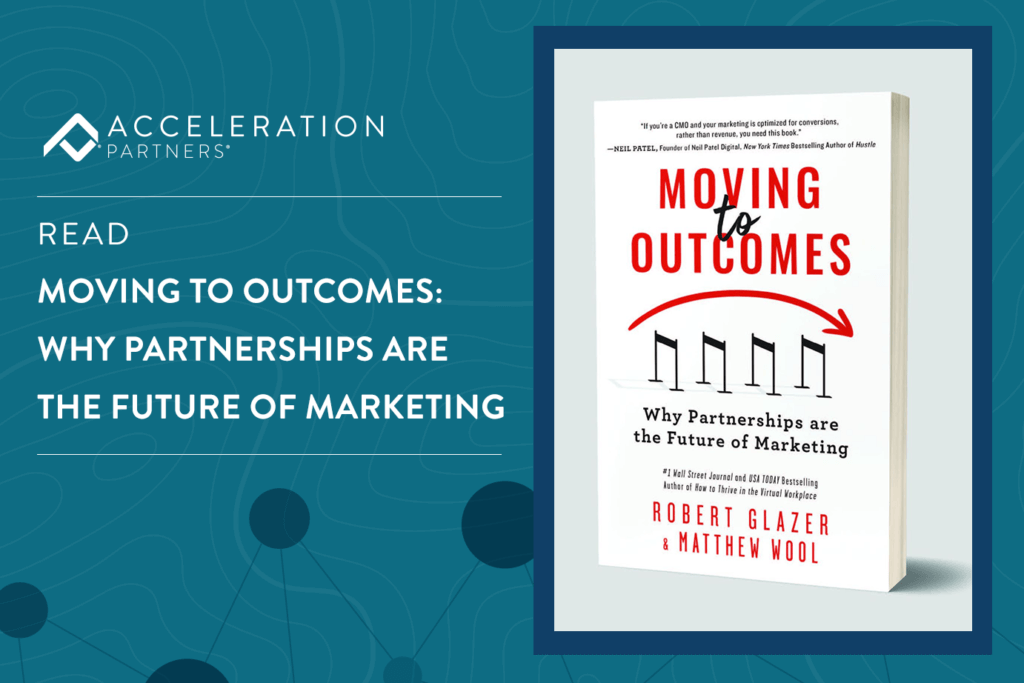
It’s a marketer’s dream to invest budget in a channel where the outcomes are set in advance and payment comes due only after those outcomes are delivered. Unfortunately, many marketers find themselves stuck the opposite: paying hefty upfront fees, without any certain ROI. In Moving to Outcomes, written by myself and Robert Glazer, we show marketers and executives how to allocate budget toward a powerful and highly profitable marketing channel that has been previously underleveraged: partnership marketing.
Partnership marketing isn’t a new concept. However, thanks to transformative changes in enabling technology and pricing models, this affiliate model now exists in a more automated, scalable form that few companies have fully leveraged to date. Marketing leaders need to understand how this channel can become a foundational part of their marketing strategy in the coming years.
The Triopoly Problem
As increasingly more brands invest in the “Triopoly” of advertising goliaths—Facebook, Amazon and Google—the demand for these services has begun to exceed supply. Consider:- In 2021, 64 percent of all digital advertising spend in the United States was invested in Facebook, Amazon and Google
- Also in 2021, Facebook raised its average ad price by 47 percent
Boost Profit Margins with Partnership Marketing
In contrast to channels such as paid search and paid social, where brands pay for impressions or clicks that don’t necessarily lead to customer acquisition, partnership marketing allows brands to pay for what works, based on their definition of success. There are two distinct advantages partnership marketing has over other digital marketing channels:- Partnership marketing provides control and sustainability, because it uses a pricing model in which companies can determine their ideal profit margins, set their costs accordingly, and pay for marketing only after a desired event occurs. Rather than leaving pricing to external parties, partnership marketing lets brands pay a previously agreed upon price for the outcomes they want.
- Partnership marketing is relationship-based and not driven solely by bidding for placements. This means companies can build partnerships and programs over time that provide them with a long-term strategic advantage over competitors.